How are your hips treating you? Do they scream at you every time you get out of the car, or try to swing your leg over the saddle? Maybe they cramp up a little when your instructor insists it’s a leg exercise day, in the saddle. Maybe they are generally quiet but then start to ache a little when you should be asleep. How far can you walk without them popping up, wanting some attention? Or is it sitting that makes them angry?
The cry of many a rider (and the general population) is a combination of a sore lower back and screaming hips. Many become so painful and dysfunctional that a full hip replacement is the only source of relief. Hip replacements are part of our landscape, becoming so commonplace that we have all seemed to accept it as an inevitable part of ageing, but why is it typically one hip that wears out before the other? Are they not both the same age?
The answer does not lie in the age of the hip, but more in how much and what type of load and tension it has been subject to over its lifetime. Typically we are all one-sided, loading one leg more than the other- a biomechanical by-product of being left or right handed.
We also are habitually forcing the body into a compressive posture; one that insists on bringing the knees towards the nose for most of the day, aka sitting down. This posture alters the positioning of the pelvis, and therefore the positioning of the hip in its socket.
The Anatomy Bit
The hip joint itself is a ball and socket joint, with strong support systems (ligaments) in and around the joint itself. Because of it’s architectural design, it has the potential for a massive amount of mobility; flexion (leg forward), extension (leg backwards), rotation (internal and external) and full rotation (leg circles). This design was manifested through evolution to enable the hips to be the main fulcrum for the body; any forward bending, squatting etc should be allowed to happen by the mobility of the hip joints. This is to protect the more delicate and vulnerable vertebrae (particularly of the lower back) which houses the vital spinal cord.
The problem the body faces in modern society is that the hips are habitually forced into a closed and flexed position; they have formed a position that can sit on a chair for hours at a time. This shortens the muscles at the front of the hip (the flexors) so much that the hip is unable to move into extension. They also tend to sit in a more internally rotated position which prevents even more mobility.
Without the freedom to move as it should, the hip slowly wears itself away. Forced into one static position, the loads it endures are focused on one area, rather than being dissipated throughout the joint.
So what can you do?
The main aim should be to re-instate some more movement at the hip joint itself, and the best way to do that is to start using it as nature intended; as the fulcrum for your body. All too often when we need to bend forward, we will incorrectly create the movement from our lower back, like this:
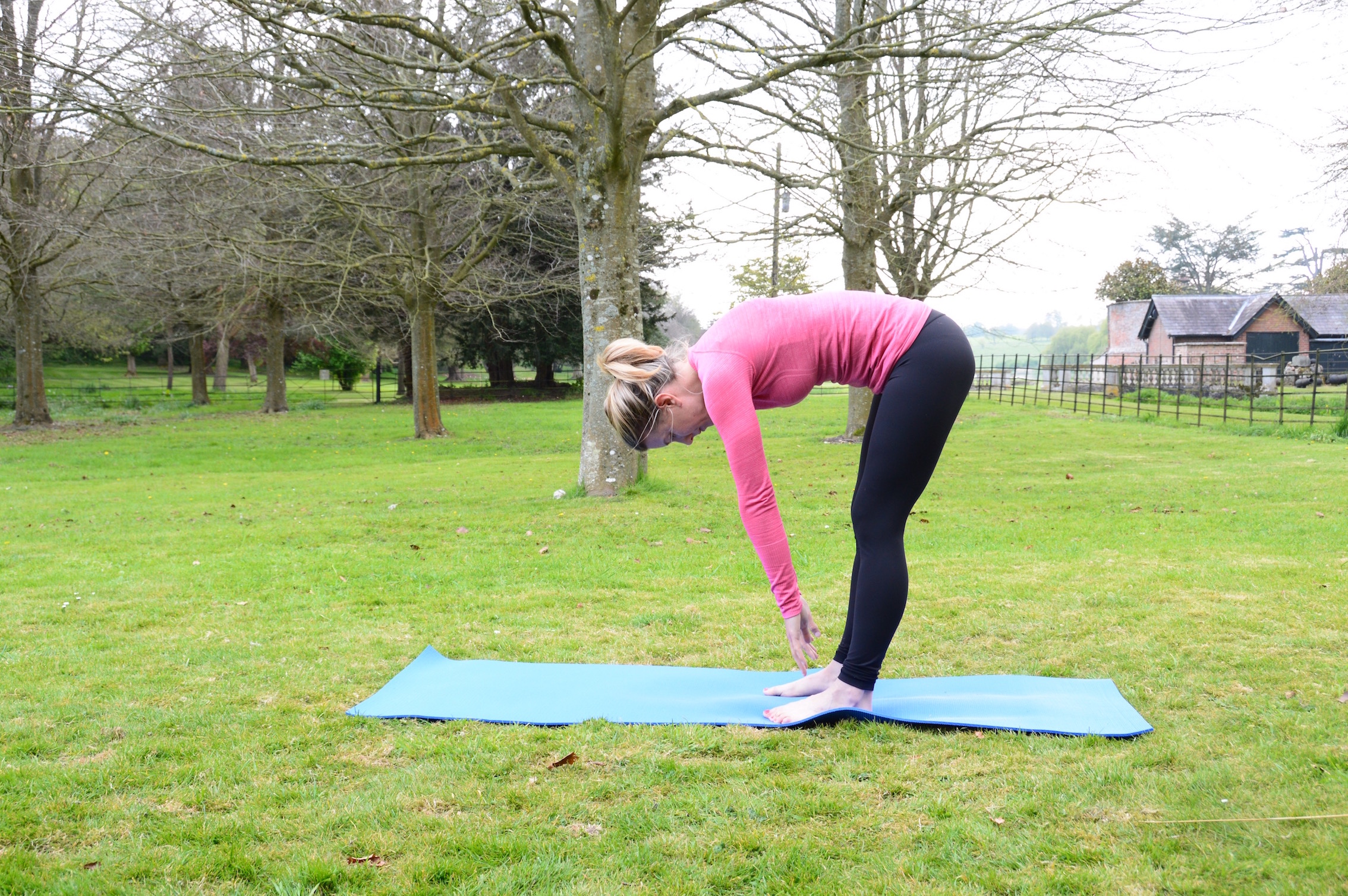
Here the lower back is rounded and I cannot reach my toes. The hips have not been moved I have just rounded my back.

Here, I have kept my back flatter and there is more angle at the hip. The knees are soft and still over the ankles. This position is achieved by pushing your bottom out behind you a little bit and aiming to keep a slight hollow at the lower back, so that it stays in neutral.
Once you have learnt how to get into this position, this should be your default way to bend every single time you need to, for example picking out horses feet, tying shoe laces, getting something from a low cupboard or fridge etc.
By mindfully keeping the hips responsible for lowering and raising the upper body, you will start to improve their mobility, which will help to reduce pain and tension.
Remember, where movement is concerned, little and often really does add up to the most benefit. See how you can incorporate this posture into your everyday life to help your hips start to cheer again!